Showing posts with label risd public engagement. Show all posts

Tuesday, May 19, 2009

The Year of Providence Initiative

Last Wednesday, a group of RISD staff, faculty and administrators gathered to celebrate the accomplishments of the Nelson Mandela: Honoring His Legacy initiative.

2008-2009 marked the first attempt to build a cross-campus dialogue around a specific theme, working with students, faculty and staff to integrate these conversations into the classroom and extracurricular activities. A full report of the activities contained within the initiative can be accessed here, including the Free Food 4 Thought dinners (with creative cuisine by RISD Catering), cross-programming with Foundation Studies, English Department, the RISD Film Series, Brown's John Nicolas Brown Center for Public Humanities, and more.


At the closing reception on Wednesday, the co-sponsors of the Nelson Mandela Initiative, the Office of International Programs, the Office of Multicultural Affairs and RISD | Public Engagement announced the launch of the 2009-2010 initiative: The Year Of Providence. This year-long acknowledgement of place and concept will kick off next September with an exhibition of Latino(a) artists at the Ewing House. Featuring work by three RISD students, three RISD faculty and 3 local artists, this exhibition encapsulates the spirit of the initiative, to connect RISD to the rich diversity of the larger Providence community, giving voice to lesser known histories of this city and its residents.

To find out how to get involved in this initiative, feel free to contact RISD | Public Engagement over the summer at 401-427-6906.

Thursday, May 14, 2009

The Manifesto Project - Photos


Micaelan Davis ( MFA ‘09 FURN)
In the envelope: I have never been one for concluding statements; even my physical work resists being neatly summed up. I see each piece as a moment in time, a specimen of work performed and ideas made real, a stop on the continuum of its evolution. I look at each piece and see the next step I would take or the next piece I would design. I am a gray thinker who longs for the black and white. I use knowledge and facts to get me a little closer to the truth, whatever that may be. When the answers don't make sense I am intrigued. I am interested in the connections between things, why we behave like we do.

Currently on view in the RISD Public Engagement Gallery: The Manifesto Project

Artwork by 11 RISD grad students from the Furniture, Textiles and Jewelry + Metalsmithing departments explore their personal creed as they pertain to being makers of thing
s.

Here are some photos from the exhibition which will be up through Friday May 15th:


Sooyeon Kim (MFA ’10 J&M)


installation view
(l-r) Peter Hedstrom (MFA ’10 FURN), Mary Gagne (MFA ‘10 TX), Erin Scully (MFA ’10 J&M)
foreground
Martin Goebel (MFA ’10 FURN)

Tuesday, May 5, 2009

President Maeda Plugs for Public Art

I just got back from testifying at the Senate Hearing for revisions to the state's 1% for Art program. In my testimony, I made reference to the letter written by President Maeda and presented to the committee by Liz Keithline of RISCA. Little did I know that most people had already read the letter in today's Providence Journal!

You too can read the letter here.

My main points were pretty simple:
1) Public art is perhaps the most accessible form of contemporary art. In a era of budget cuts in the schools and after-school programs, it is important that public art exist to enliven our shared landscapes.
2) While few of our RISD faculty or students (or community artists for that matter) have the expertise to navigate the world of permits, insurance, and six-figure budgets necessary to execute these large scale public artworks, RISD offers an ideal pool of candidates for smaller scale temporary work. Often emerging artists grow into full sized public art works only after getting their feet wet working on smaller-scale, performance or installation based, projects. So direct some portion of that 1% towards these works!
3) Open up opportunities for RISD students and classes to learn first-hand about the public art selection process by sitting in on these convenings. The participation of RISD faculty on a more permanent selection panel would be invaluable in terms of curating a truly innovation public art program for the state.
4) As taken from Janet Zweig's letter of support - In the Providence Journal article dated April 23rd, 2009, titled "Can Rhode Island still afford to pay for public art?" the first sentence states that "Over two decades, Rhode island has spent nearly 3 million dollars on public art..." While 3 million dollars sounds like a lot of money, by this calculus, Rhode Island has spent $150,000 per year on public art. This is far below the national standard, even when the state's size is considered.

The committee meets for its final public testimony hearing on May 12th @ 2:30.

All in all it was a good day up on the hill for art in Providence.

Monday, May 4, 2009

AmeriCorps*VISTA Position at RISD | Public Engagement

Applications due June 1st

RISD | Public Engagement seeks candidates for an AmeriCorps*VISTA position that will run from 30 July 2009 to 29 July 2010. This AmeriCorps*VISTA position is sponsored through the Rhode Island Campus Compact and will be placed at Rhode Island School of Design. The VISTA member will work closely with the director of RISD | Public Engagement to advance the strategic goals of the Office.

Specific VISTA Responsibilities:

Communication
• Developing communication about public engagement across the College;
• Communicating with community agencies about RISD | Public Engagement’s existing work;
• Working with the director to communicate public engagement opportunities through existing student and academic services offices;
• Assisting with the development of content for the Office’s web site;
• Coordinating a weekly electronic newsletter for the office;

Community Outreach
• Building our database of community partners;
• Working with potential community partners to assess opportunities for collaboration;
• Meeting with community agencies to determine how RISD can support existing services and establish new long-term partnerships;

Academic Support
• Assisting with the development of our service-learning initiative;
• Coordinating information for faculty about service-learning resources;
• Coordinating meeting of RISD’s faculty forum on service learning;
• Assisting the development of new community-arts/design programs and coordinating existing partnerships;
• Supporting students and academic departments in the development of new, on-going initiatives;

Extracurricular Support
• Assisting the development of our campus sustainability initiative;
• Coordinating events open to students and faculty that promote community involvement;
• Advising students about possible service programs;
• Assisting the director to coordinate service programs;

Qualifications:
• Familiarity with community-based art and design programs;
• Familiarity with a four-year undergraduate institution;
• Strong organizational skills;
• Ability to communicate across difference and with a diverse set of constituents; a commitment to supporting inclusive learning environments and workplaces;
• BA degree

Questions and Application
Please direct questions and inquiries about the position to Peter Hocking, Director of RISD | Public Engagement – phocking@g.risd.edu or 401-413-0275. A formal application can be submitted at: www.compact.org/ricompact/vista/join.php

About AmeriCorps*VISTA

AmeriCorps*VISTA (Volunteers in Service to America) is one of several full time national service programs. VISTA members who are interested in developing lasting solutions to the problems of poverty in America serve in nonprofit organizations and agencies to develop and expand services, strengthen programs and empower low-income individuals. For more information about the program, please visit the RI Campus Compact web site.

About RISD | Public Engagement
The Office of Public Engagement works with faculty, students, alumni, and community partners to connect art, design and scholarship with the public good. Reflecting the values of the College, RISD | Public Engagement believes that public participation is a central concern of a college education. Recognition of one's social responsibility and one's ability to affect public issues is intrinsic to understanding one's role in a democratic society and key to addressing the most pressing questions that face us -- locally nationally and internationally. For more information about us, visit our web site.

Friday, October 17, 2008

Play Space Collaborate

This month marks the beginning of a new collaboration between RISD, the Learning Community Charter School, and New Urban Arts.

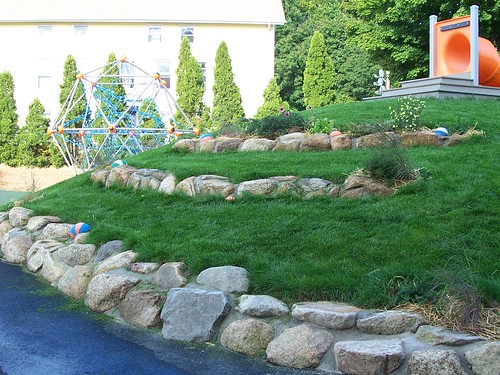
September 26th saw the official opening of the Learning Community’s new play space (you can read more about that here,), after months and months of conversations and committee meetings between students, staff, and parents of TLC. The school selected Laurencia Strauss, a recent RISD graduate from Landscape Architecture department, to synthesize this mass of information into a cohesive design.


Upon receiving an invitation to the opening, I had gotten the idea in my head to make a short experiential video of the kids’ movements and play, but rain and chaos deterred the initial plan. Instead, at the opening I entered into a conversation with Laurencia and Kath Connelly, the school’s Communications and Outreach Coordinator, about how to share the missing pieces of the story of this collaboration to the larger audience of RISD and beyond.

While much has been made of the entrepreneurial spirit of the six fourth-graders who formed the Playground Committee and were responsible for the letter to the CEO of Loews, which resulted in a $110,000 grant, we wanted to highlight the elements of the collaborative process and Laurencia’s own artistic vision which moved the project from seed to completion. The question became how to expand on the idea of a more traditional reporting piece to a video that captures the dynamic learning experience that underwrote this entire project.

To get started, Kath invited Andrew Oesch, one of the New Urban Arts artist mentor fellows, and I to spend an afternoon perched in the second floor stairwell of the Learning Community observing how the different classes were using the new playground. While it felt strangely big-brotheresque whenever a kid would glance up and catch us staring back from the second floor window, this perspective allowed us to witness the overall flow of movement around the playground while still being close enough to catch the nuances of individual group dynamics.
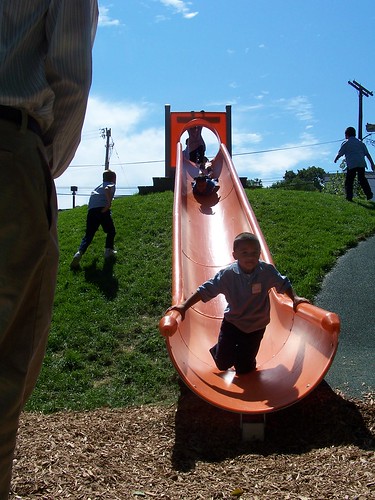
What did we see? Fifth graders, followed by the kindergarteners, explode out onto the playground, most racing straight up the hill. Some made a beeline for the sandbox, and still others just ran a few laps before settling into a game of dodge ball, basketball, or just plain “kick the ball!”

There was a constant shifting of energy – at one point the entire playground clustered en masse in the matter of seconds (was someone hurt? was it a big bug?), only to disperse as quickly once they’d diagnosed the situation. There were also diverse ways in which different age groups used the same spaces. For instance, the kindergarteners piled and sorted leaves on top of the wood stump tables on the stage (girls at one “table” and boys at the other), while the older students used that space for one-on-one conversations (also gender-divided). Older kids had figured out that their jackets made great surfboards for going down the slide faster – kneeling, standing, face-first – while the younger groups proceeded in more orderly fashion.

There really isn’t enough time to go into all of the amazing things we watched transpire, but needless to say Andrew and I were wide-eyed and captivated by the sheer amount of human energy being exerted in a relatively small amount of space!

When Kath joined us, we served as a kind of sounding board for many of the reflections she’s been processing over the last year of this project. As the person who worked most closely with Laurencia, she was particularly attuned to the finer subtleties of the dynamics that played out over the year long collaborative process.

Some of the points she brought up will be great to develop further during the video interviews. These include: the pedagogical overlap with the built environment, the importance of setting up basic parameters in the built environment while also letting go of how the space gets used (both for the designer and the school,) unintended uses of the playground and how the neighborhood has embraced the space as a community park, how Laurencia took abstract concepts that came from the kids and staff and created spaces and objects flexible enough to handle multiple uses, etc.

Kath also introduced us to Ms. Kathy, the third grade teacher whose classroom overlooks the playground. At the beginning of the year, Ms. Kathy quickly recognized that the students’ attention was being drawn to the giant colorful space outside their windows. Her ingenious response was to build into the curriculum a journaling project in which the students wrote about and then investigated their continued wonderings about the new playground. How to employ this new space as a kind of learning lab is one of the exciting new arenas the school will be exploring over the course of the next several months.

The next day, I met up with Laurencia, which helped to build upon the conversations that I’d been having with Andrew, Kath, and Ms. Kathy. There is a shared sense that this video piece can be a way for Laurencia to engage in her own reflection about the process of building the play space. She had been so involved in the day-to-day logistics that only now is she beginning to articulate what actually happened.

Specifically we spoke at length about what makes an artist well suited to collaborative or community-engaged art practices and that delicate dance between personal vision and incorporating multiple perspectives and desires. This led to an interesting conversation about how universities can best support the students on campus who are drawn to a collaborative mode of art making. Which also raises the contrary question of whether a school environment is the most appropriate place to explore/introduce community-based projects at all.

Given the artificial timeframe of semesters and the focus on individual creative vision and a strong commitment to studio practice, is it possible to realize collaborative projects where on-going relationship-building and deep listening are prerequisites to the project’s success?
This I believe is one of the many challenges in building and sustaining university-community relationships in collaborative projects. For this specific project, Kath’s role as mediator will prove to be invaluable. Through her clear articulation of how the school emboldens students to build literary and communication fluency, we are better able to create a platform for new learning opportunities by all parties.